


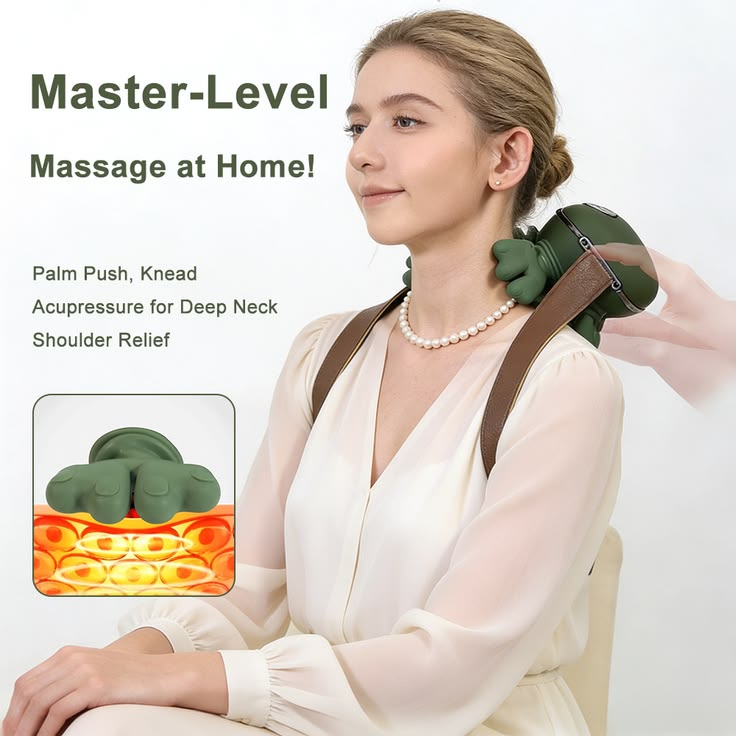
Deep tissue massage is often associated with firm, deliberate pressure applied by trained hands—especially knuckles, thumbs, and elbows. Among these, the knuckle knead is particularly effective for reaching stubborn muscle knots because it concentrates force into a small, precise contact area. Modern massage engineering has attempted to replicate this sensation through specialized mechanical nodes found in hand and neck massagers.
These “knuckle-style” nodes are not just simple rotating parts. They are carefully designed structures that mimic the shape, pressure behavior, and movement pattern of a human knuckle working through tight muscle layers Hand shoulder massager.
Why Knuckle Pressure Is So Effective
Knuckles are uniquely suited for deep tissue work because of their structure and leverage.
1. Focused Pressure Point
A knuckle delivers force through a small surface area, allowing deeper penetration into muscle tissue.
2. Controlled Stability
Unlike fingertips, knuckles maintain firm structural alignment under pressure.
3. Efficient Force Transfer
The arm and wrist can apply stronger, more sustained pressure through knuckles without fatigue.
What Specialized Massage Nodes Are Designed to Copy
Modern “knuckle knead” systems aim to replicate three key characteristics:
1. Firm, Rounded Contact
Mechanical nodes are shaped to imitate the curved surface of a bent finger joint.
2. Rotational Movement
Instead of static pressure, nodes rotate in circular or semi-circular patterns similar to a therapist’s hand motion.
3. Variable Depth Contact
Advanced systems adjust how far nodes extend into muscle tissue during each cycle.
The Engineering Behind Knuckle-Style Nodes
Creating a mechanical version of a knuckle requires precision design.
1. Asymmetrical Node Geometry
Nodes are often slightly offset or contoured to avoid uniform pressure.
Effect
- Creates more natural pressure variation
- Mimics human inconsistency in massage motion
2. Multi-Directional Rotation Systems
Rather than spinning in one axis, nodes move in complex patterns.
Function
- Simulates circular kneading
- Reproduces shifting knuckle angles
3. Elastic Outer Layering
Many nodes are covered with silicone or gel-like materials.
Purpose
- Softens direct mechanical contact
- Enhances comfort while maintaining depth
4. Pressure Modulation Motors
Internal motors adjust speed and force dynamically.
Result
- Alternating deep and light pressure cycles
- More realistic massage rhythm
How Knuckle Kneading Targets Deep Muscle Layers
Deep tissue therapy focuses on reaching beyond surface muscle tension.
1. Fascia Release
Knuckle pressure helps loosen the connective tissue surrounding muscles.
2. Trigger Point Activation
Focused force targets localized knots that restrict movement.
3. Muscle Fiber Alignment
Repetitive motion encourages relaxed muscle positioning.
Why Knuckle Simulation Feels More Intense
Compared to flat or vibrating massage, knuckle-style nodes feel stronger because:
1. Smaller Contact Area
Pressure is concentrated rather than dispersed.
2. Deeper Penetration
Curved nodes push into muscle layers more effectively.
3. Rhythmic Compression
Alternating pressure creates a deeper sensory response.
The Role of Heat in Enhancing Knuckle Kneading
Heat therapy complements mechanical pressure.
1. Softens Muscle Resistance
Warm tissue allows deeper node penetration.
2. Improves Elasticity
Muscles respond more fluidly to rotational motion.
3. Enhances Comfort
Reduces discomfort during deep pressure cycles.
Where Knuckle-Style Nodes Are Most Effective
Neck and Upper Trapezius
Ideal for stress-related tension buildup.
Shoulder Blades
Helps release deep postural knots.
Upper Back
Targets long-term stiffness from sitting or lifting.
Common Misconceptions About Deep Kneading Technology
“Stronger Is Always Better”
Excess force can cause muscle guarding instead of relaxation.
“All Nodes Work the Same”
Shape, motion, and material all influence effectiveness.
“Instant Results Mean Lasting Relief”
Deep tissue release often requires consistent use over time.
Best Practices for Using Knuckle Knead Massagers
1. Start at Lower Intensity
Allows muscles to adapt gradually to deep pressure.
2. Focus on Short Sessions
10–15 minutes per area is often sufficient.
3. Avoid Direct Bone Pressure
Target muscle tissue, not skeletal joints.
4. Combine With Gentle Movement
Light stretching after massage improves long-term flexibility.
Why Knuckle Simulation Improves Realism
The success of these systems lies in their ability to mimic human variability.
Human Massage Is Not Uniform
Real therapists:
- Adjust pressure constantly
- Change angles dynamically
- Respond to muscle feedback
Mechanical Replication
Modern devices achieve this through:
- Variable motor speeds
- Multi-axis rotation
- Adaptive pressure systems
Final Thoughts
The knuckle knead represents one of the most advanced attempts in massage engineering to replicate the precision and depth of human deep tissue therapy. By combining shaped nodes, controlled rotation, and adaptive pressure systems, modern hand and neck massagers can deliver focused relief that closely resembles skilled manual techniques.
While not identical to professional therapy, these systems effectively bring deep muscle stimulation into a portable, at-home format—making consistent recovery more accessible for everyday muscle tension and chronic stiffness.
